

SAP Data Migration: Steps, Tools, Risks and Data Quality Best Practices
This guide gives a broad overview of SAP data migration — what it involves, how the main steps work, which tools are used, and why data quality must be managed before the SAP Migration Cockpit loads data into S/4HANA.
|
Quick answer SAP data migration is the process of moving business data from legacy systems such as SAP ECC into SAP S/4HANA. It typically involves extracting data from source systems, preparing and cleaning it in a dedicated staging layer, mapping it to S/4HANA structures, loading it through tools such as SAP Migration Cockpit, and verifying that migrated data is complete, consistent, and usable after go-live. Data quality issues are one of the recurring causes of SAP migration delays, alongside change management, custom code remediation, integration complexity, and project governance. |
Migrating from SAP ECC to SAP S/4HANA has become a priority for many organizations as SAP Business Suite 7 mainstream maintenance runs until the end of 2027, followed by optional extended maintenance until 2030. The migration affects every business domain — customers, vendors, materials, finance, inventory — and sets the data foundation on which the new system will operate for years.
This guide explains what SAP data migration involves, how the main steps work, which tools are used, what the common risks are, and why data quality must be addressed before the SAP Migration Cockpit loads data into S/4HANA.
|
What this guide covers
|
What Is SAP Data Migration?
SAP data migration is the process of moving business master data and transactional data from a source system — typically SAP ECC — into SAP S/4HANA. The scope typically covers:
- Customer master data and vendor master data (consolidated as Business Partners in S/4HANA)
- Material Master — products, raw materials, semi-finished and finished goods
- Financial data — GL accounts, chart of accounts, cost centers, profit centers, open items
- Inventory and stock data — warehouse positions, batch management, serial numbers
- Purchasing and sales master data — contracts, pricing conditions, supplier and customer hierarchies
SAP data migration is not just a technical transfer. It is a business project: the accuracy, completeness, and consistency of the data that enters S/4HANA determines how the system performs from day one. A technical migration that loads incomplete or duplicated data creates operational problems — blocked orders, wrong invoices, unreliable reporting — that are significantly more costly to fix after go-live than before.
SAP S/4HANA has a fundamentally different data model than ECC. The most significant structural change is the Business Partner — a unified object that replaces the separate customer (KNA1) and vendor (LFA1) tables. Customer and vendor records in ECC must be prepared for conversion into the S/4HANA Business Partner model, which makes duplicate detection and consolidation a critical pre-migration task.
S/4HANA Migration Approaches: Brownfield, Greenfield, and Selective
Brownfield migration (system conversion)
The existing SAP ECC system is converted in place into S/4HANA. All data — historical transactions, configuration, custom developments — is carried over and transformed. Brownfield migrations tend to be faster to implement but require more rigorous data quality work upfront: everything in ECC comes with you, including duplicates, incomplete records, and obsolete entries accumulated over years.
Greenfield migration (new implementation)
A new S/4HANA system is built from scratch. Only selected, validated data is migrated — typically master data and open transactions. Greenfield migrations take longer to implement but offer the opportunity to migrate only clean, business-approved data into the new system.
Selective data transition (hybrid)
A combination: the system is partially converted and partially rebuilt. Used when organizations want to restructure their company code structure, merge legal entities, or migrate only specific business units. Across all three approaches, one constraint holds: the data that enters S/4HANA must be accurate, complete, unique, and consistent. The approach changes the scope — not the quality standard.
How SAP Data Migration Works: From ECC Extraction to S/4HANA Go-Live
A SAP data migration project follows a defined sequence of steps. Compressing or skipping any of them is where most migration delays originate.
- Define migration scope — identify which data objects migrate, which are excluded, and which need transformation.
- Extract data from source systems — ECC data is exported and loaded into the staging layer. Multiple source systems may feed into a single staging environment.
- Profile and clean data in the staging layer — automated profiling identifies duplicates, missing mandatory fields, inconsistencies, and obsolete records. This is the most time-intensive phase and the one most frequently underestimated.
- Business validation — domain owners from procurement, finance, and operations review and approve correction decisions. Supplier merges, material exclusions, and GL account mappings cannot be validated by IT alone.
- Map data to S/4HANA structures — source fields are mapped to S/4HANA target fields. The Business Partner mapping and the Universal Journal chart of accounts structure are the most complex.
- Load with SAP Migration Cockpit — SAP Migration Cockpit supports the transfer of prepared migration objects into S/4HANA and performs technical checks during the load process. It does not replace upstream business data quality remediation.
- Mock migration and validation — full dress rehearsal loads confirm that data is complete, that business processes run correctly, and that no errors remain before the production cutover.
- Production cutover and go-live — the final migration run. After cutover, data quality issues discovered are significantly more costly to resolve.
SAP Migration Cockpit transfers data. But the accuracy, uniqueness, and completeness of the data must be ensured in the staging layer before the Cockpit runs.
SAP Data Migration Tools: Migration Cockpit, Staging Layer, and Data Quality Platforms
No single tool covers the entire SAP data migration process. The four main layers each serve a specific role — understanding their limits is essential before planning the project.
|
Tool / layer |
Role |
Limit |
|
SAP Migration Cockpit |
Loads prepared data into S/4HANA from staging tables or supported source connections |
Does not replace upstream data quality remediation — data must be clean before load |
|
ETL / scripts / BODS / SQL |
Extract, transform, and map data from source systems to staging |
Technical; limited business team access; auditability varies by implementation |
|
SAP MDG |
Governs master data quality after go-live |
Can be heavy to deploy solely for short-term pre-migration cleansing |
|
Data quality platform (e.g. Tale of Data) |
Profiles, deduplicates, validates, remediates, and traces staging data before Migration Cockpit load |
Complements SAP tools — does not replace SAP Migration Cockpit or post-migration governance |
For a deeper comparison of SAP data quality tools and approaches, read: Data Quality Management SAP: how to choose the right approach
Common SAP Data Migration Risks
Most SAP data migration delays and post-go-live issues trace back to the same categories of problems. Identifying them early — in the staging layer, before mock migration — is the difference between a controlled remediation cycle and a crisis under cutover pressure.
- Duplicate customer and vendor records — S/4HANA requires one Business Partner per legal entity. Duplicates must be resolved before load.
- Missing mandatory CVI fields — BP category, BP grouping, country, tax scheme. Records missing these fields may trigger load errors.
- Unit of measure inconsistencies — materials defined with different units of measure across plants generate errors at S/4HANA validation.
- GL account inconsistencies across entities — S/4HANA's Universal Journal aggregates all financial postings in a single table. Account configuration differences create reporting errors from the first posting.
- Obsolete or inactive records in migration scope — add test and load volume without business value. Scope reduction on inactive data lowers migration risk.
- Weak business validation — without named data owners per domain, cleansing decisions stall. This is a common cause of data preparation delays.
- Discovering issues too late — data quality problems found during mock migration leave limited time for correction before the scheduled cutover.
|
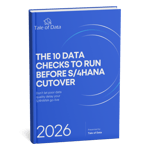
Want to validate these risks against your own data before cutover? The SAP Data Migration Best Practices guide covers 10 data quality checks — Business Partner, Material Master, Financial Data, and Governance — with the key criteria to review before scheduling cutover. |
Why Data Quality Must Be Managed Before SAP Migration Cockpit Load
SAP Migration Cockpit supports the transfer of prepared migration objects into S/4HANA and performs technical checks during the load process. Project teams remain responsible for ensuring that the data in staging is accurate, complete, deduplicated, and business-approved before the Cockpit runs.
The staging layer is where data quality work happens. ECC records are extracted into a dedicated database environment — typically Oracle, SQL Server, Snowflake, or Databricks — where profiling, deduplication, enrichment, and validation occur. Once the staging data meets quality thresholds, the Migration Cockpit loads it into S/4HANA.
Horváth's 2025 research on 200 S/4HANA transformations found that fewer than one in ten implementations stayed on schedule, with projects taking on average 30% longer than planned. SAPinsider's S/4HANA migration research consistently identifies data quality as one of the top challenges faced by organizations that have already migrated. For ETI-scale migrations, starting data quality preparation at least six months before go-live is a safer planning benchmark. Starting later reduces the number of profiling, validation, and remediation cycles available before cutover and increases schedule risk.
What to Assess Before S/4HANA Cutover
Before scheduling cutover, migration teams need a clear view across four areas. This is not an exhaustive checklist — it is the frame that helps prioritize the pre-migration data quality workstream.
- Data scope — which data objects migrate and which are excluded or archived. Scope decisions made late create remediation work under pressure.
- Master data quality — Business Partner duplicates, missing mandatory CVI fields, unit of measure inconsistencies, GL account harmonization.
- Business validation — who validates correction decisions for each domain. Supplier merges, material exclusions, and financial mappings require named domain owners.
- Traceability — how every correction is documented with its source, rule, owner, and date. Correction lineage is required for internal controls and audit sign-off.
|
Need a project-ready checklist? Download the SAP data migration readiness checklist to review the key checks, GO thresholds, and scoring grid before cutover. |
How Tale of Data Supports SAP Data Migration Readiness
Tale of Data is an AI-powered no-code data quality platform that connects to the staging layer before SAP Migration Cockpit load. It profiles ECC extracts, identifies duplicate Business Partner candidates, detects missing mandatory fields, flags unit of measure inconsistencies, and enables business teams to validate and apply corrections without writing SQL queries.
Every correction is automatically documented with its source, rule, owner, and timestamp — producing the lineage required for audit compliance. Tale of Data does not replace SAP Migration Cockpit, SAP MDG, or the role of your SAP integrator. It fills the gap between ECC extraction and S/4HANA load — profiling, remediating, validating, and documenting staging data before it enters S/4HANA.
For a detailed look at how to manage SAP data quality before migration — read: Data Quality Management SAP: A Practical Guide — taleofdata.com/blog/data-quality-management-sap
|
Prepare your SAP migration data before cutover Start with the checklist to assess staging data quality, Business Partner duplicates, and correction lineage with your project team. Then request a Flash Audit for a first view of your actual data quality risks. |

SAP Data Migration Best Practices: 10 S/4HANA Data Checks

Data Quality Management SAP: S/4HANA Migration Guide